TheGHoppers - theghoppers.com
Skip
History

History

Diablo I

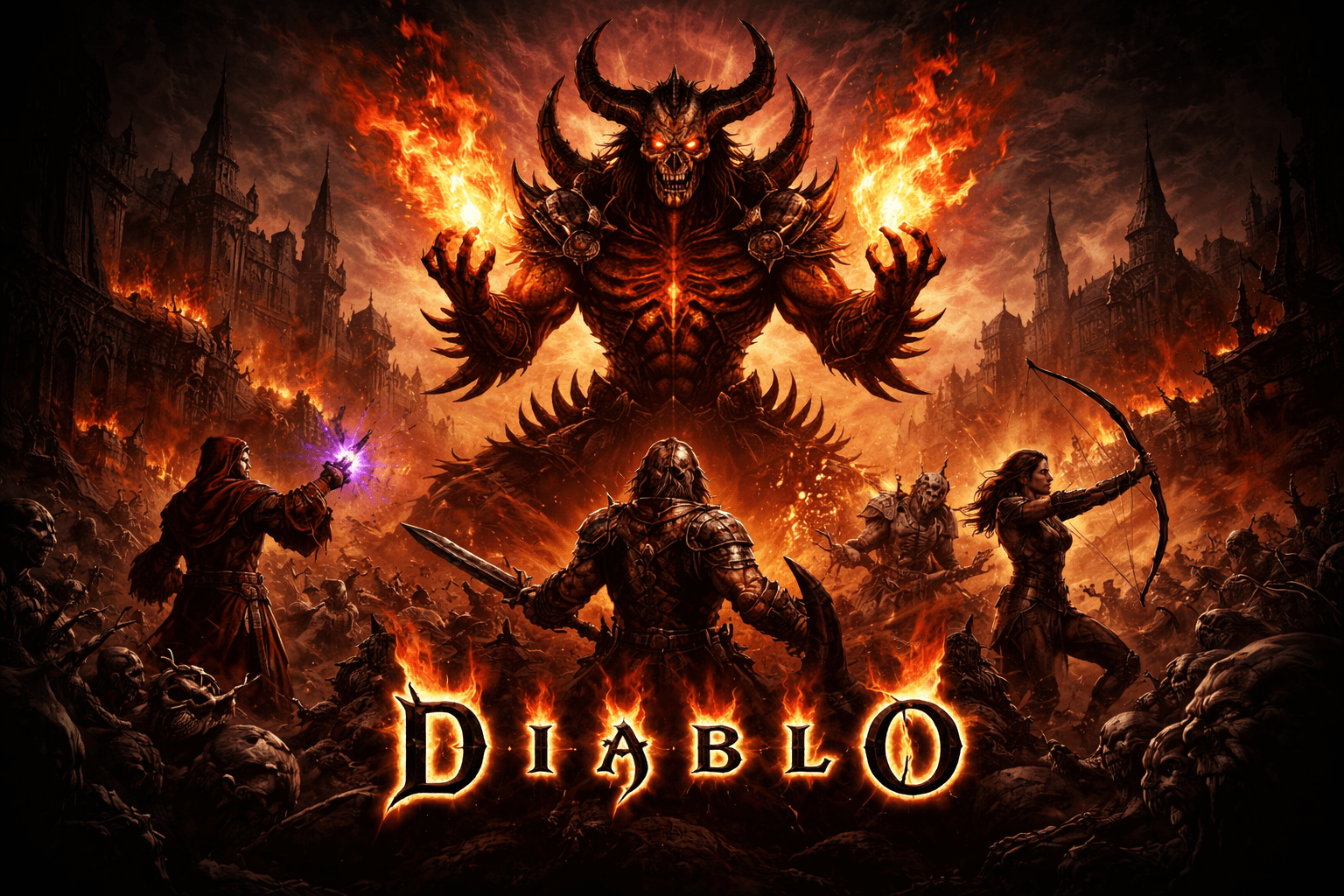
Diablo is the game that defined the action-RPG. It was built by Blizzard North — the Redwood City studio founded in 1993 as Condor by David Brevik with brothers Erich and Max Schaefer — and published by Blizzard Entertainment. Copies reached some North American shelves on 31 December 1996, ahead of the official launch announced for 3 January 1997.

The whole game is a single descent: sixteen randomly generated levels beneath the cathedral of Tristram, ending in the chamber of Diablo, the Lord of Terror.

At a glance
  • Developer: Blizzard North (formerly Condor).
  • Publisher: Blizzard Entertainment.
  • Released: 31 December 1996 / 3 January 1997 (PC, North America), 2 November 1997 (Europe), 30 March 1998 (PlayStation), 8 May 1998 (Mac OS).
  • Classes: Warrior, Rogue, Sorcerer.
  • Dungeon: 16 levels — Cathedral, Catacombs, Caves, Hell.
  • Multiplayer: up to four players over Battle.net, LAN, modem or direct link.
Why it mattered
  • Condor first pitched Diablo as a turn-based dungeon crawler. The late switch to real-time, click-to-move combat is what gave the whole genre its pace.
  • Levels, monsters and loot are randomised, so no two descents are the same.
  • Randomly rolled prefixes and suffixes on items created the "one more run" loot loop every action-RPG has copied since.
  • Battle.net launched alongside Diablo and made free online play a standard PC feature — together with the open-character duping and hacking that came with it.

Diablo: Hellfire

Hellfire is the single-player expansion to Diablo, developed by Synergistic Software and published by Sierra On-Line under licence — not by Blizzard, and not by Blizzard North. It shipped in North America on 25 November 1997, less than a year after the base game, and reached Europe in 1998.

  • Developer: Synergistic Software (a Sierra studio).
  • Publisher: Sierra On-Line.
  • Released: 25 November 1997 (North America); 1998 (Europe).
  • Requires: Diablo.
  • Mode: single-player only — no Battle.net, no multiplayer of any kind.

It remains the only official expansion the original Diablo ever received: a fourth class, two new dungeon branches, a new final demon, plus quests, monsters, spells and items layered on top of the 1996 game.

The Story of Diablo

The Story of Diablo

The tale of Diablo begins long before the hero ever sets foot in Tristram. In the world of Sanctuary, the endless war between the High Heavens and the Burning Hells spilled over onto mortal soil. The three Prime EvilsDiablo, the Lord of Terror; Mephisto, the Lord of Hatred; and Baal, the Lord of Destruction — were banished to the mortal realm and bound within enchanted soulstones by a secret order of mages known as the Horadrim.

Tristram and the Hidden Soulstone

Diablo's soulstone was buried deep beneath the town of Tristram, hidden under the monastery cathedral so its evil could never again touch the world. Over the centuries the seal weakened, and the Lord of Terror reached out to corrupt those above.

King Leoric, the Black King

The mad Archbishop Lazarus, secretly a servant of Diablo, drew King Leoric of Khanduras and his court to Tristram. Diablo first tried to possess the king, but Leoric's will resisted — and the struggle drove him insane. His cruelty earned him the name the Black King, and after his death he rose again as the dreaded Skeleton King.

Prince Albrecht

Failing with the father, Lazarus lured the king's younger son, Prince Albrecht, down into the labyrinth. There Diablo seized the child's body to take physical form once more, and the cathedral's depths twisted into a gateway to Hell itself.

The Hero's Descent

A lone champion — in series canon the warrior Aidan, Leoric's elder son — descends the sixteen dungeon levels beneath Tristram, completing the quests of its desperate townsfolk, defeating Archbishop Lazarus, and at last confronting Diablo on the final level. To contain the demon, the hero drives Diablo's soulstone into his own forehead — a fateful act that fails to hold the evil and sets the stage for the Dark Wanderer of Diablo II.

Key Figures
  • Diablo — the Lord of Terror; the final boss, waiting on dungeon level 16.
  • King Leoric — the maddened Black King who returns as the Skeleton King.
  • Archbishop Lazarus — the corrupt priest who unleashed the evil beneath the cathedral.
  • Prince Albrecht — Leoric's younger son, whose body Diablo possesses.
  • Deckard Cain — the last of the Horadrim and Tristram's keeper of lore.

For deeper retrospectives and full lore breakdowns, see the Videos tab.

No words have been spoken yet. Be the first to break the silence.

Log in to join the discussion.

Release & Legacy

Reception
  • More than 450,000 pre-orders by December 1996, and half a million copies sold by April 1997 — the best-selling computer game in the United States for the first half of that year.
  • Past 2.5 million copies by mid-2001.
  • Game of the Year from Computer Gaming World, GameSpot and others; the review aggregate still sits around 94/100.
Ports and re-releases
  • PlayStation (1998), ported by Climax Studios, with two-player split-screen — an early proof that the genre worked on a controller.
  • Mac OS (1998).
  • Sold again on GOG.com from March 2019, patched to run on modern Windows; the Hellfire expansion was added to that release free in June 2019.
Legacy
  • Every action-RPG that followed — Diablo II, Titan Quest, Torchlight, Path of Exile, Grim Dawn, Last Epoch — is built on the loop Diablo established: descend, kill, loot, repeat.
  • DevilutionX, an open-source reimplementation of the original engine, keeps the game running on modern PCs, phones and handhelds with widescreen, restored multiplayer and mod support. It needs the original game files to run.
  • Blizzard North's founders left in 2003 and the studio was closed in 2005, but its people went on to found Flagship Studios, Runic Games and Gazillion.
  • Diablo III rebuilds the original sixteen levels every January in the Darkening of Tristram anniversary event, retro filter and all.

What Hellfire Adds

The Monk

A fourth class built around the staff. The Monk fights well unarmed, favours light armour, gains his own spell selection, and plays faster and more fragile than the Warrior he sits beside.

New dungeons and a new demon
  • The Hive (the Festering Nest) — four levels of demonic insects, entered through the cornfield outside Tristram.
  • The Crypt — four levels reached beneath the cathedral, ending at Na-Krul, a demon lord sealed behind three runic wards. Break the wards first and he wakes at full strength; open them properly with the books and he is weakened.
New systems and items
  • Oils that permanently improve an item — damage, armour, durability or requirements.
  • Runes laid on the ground as traps, a first pass at an idea Diablo II would take much further.
  • New spells including Search, Immolation, Lightning Wall, Reflect and Berserk.
  • New unique items, item affixes, shrines and monster families, plus extra quests such as the Cornerstone of the World.
  • Optional quality-of-life switches — running in town among them — unlocked through command-line flags and configuration files.
The hidden classes

The Bard and Barbarian sit unfinished in the code, reachable only by editing files or launching with special switches. They reuse Rogue and Warrior artwork, have no story of their own, and were never completed.

Reception & Legacy

Blizzard did not build Hellfire and would not allow it onto Battle.net, unwilling to support online code the company had not written. Single-player-only was fatal for an audience that had moved online, and the expansion has always been treated as an aside rather than canon — no later Diablo game references its story.

  • Reviews were mixed: real content, but rougher balance, a thin story and no multiplayer.
  • The Monk it introduced is unrelated to the Diablo III class of the same name.
  • Blizzard released Hellfire free on GOG.com on 5 June 2019, bundled with the Diablo re-release, which is how most players reach it today.
  • DevilutionX supports Hellfire and can even blend its content into the base game, making it far more playable than it was in 1997.

Judged as an expansion it is a curiosity. Judged as extra Diablo, it is several more hours of the dungeon and the only official one there will ever be.

Why Diablo 1(1996) Was Great

Created by: MadSeasonShow

Created at: Feb 1, 2026

No words have been spoken yet. Be the first to break the silence.

Log in to join the discussion.

30 Years Later And Diablo 1 Is Still The Best Diablo

Created by: Victor's Retro Paradise

Created at: Feb 11, 2026

No words have been spoken yet. Be the first to break the silence.

Log in to join the discussion.

Is Diablo 1 Worth Your Time in 2026?

Created by: GhostsOnHoliday

Created at: Feb 1, 2023

No words have been spoken yet. Be the first to break the silence.

Log in to join the discussion.

Diablo 1 | The Full Story (Including All Cut Quests)

Created by: Dark Side Dash RPGs

Created at: Feb 19, 2021

No words have been spoken yet. Be the first to break the silence.

Log in to join the discussion.

Diablo 1 Rogue | Complete Playthrough | Longplay | No Commentary

Created by: Frank #MuseumOfGaming

Created at: Jun 23, 2026

No words have been spoken yet. Be the first to break the silence.

Log in to join the discussion.

Diablo - A Complete Retrospective

Created by: Jwlar

Created at: Jun 23, 2026

No words have been spoken yet. Be the first to break the silence.

Log in to join the discussion.