TheGHoppers - theghoppers.com
Skip
History

History

Diablo II: Lord of Destruction

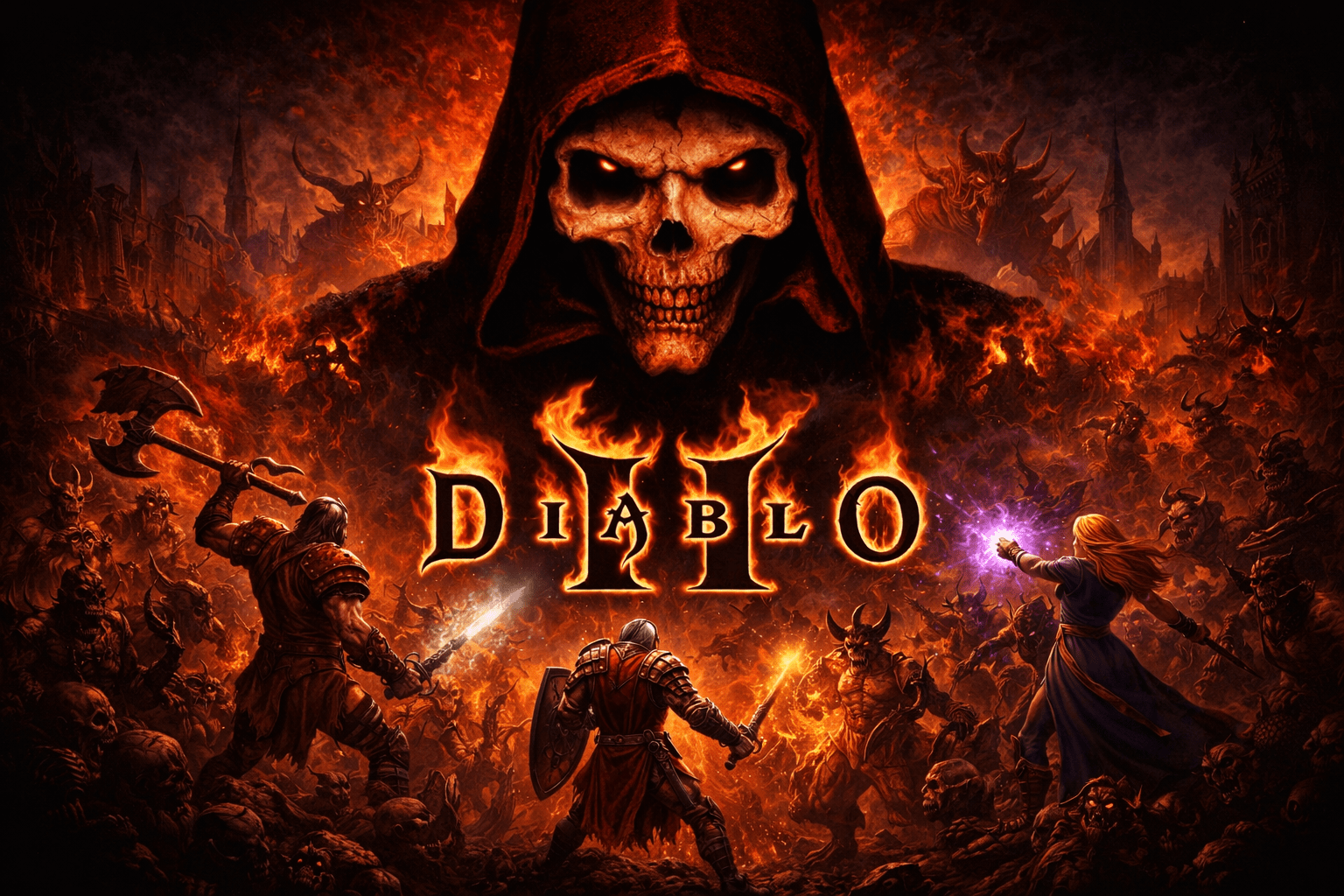
Lord of Destruction is the expansion to Diablo II, developed by Blizzard North and released on 27 June 2001, one year after the base game. It adds a fifth act on the slopes of Mount Arreat, two new classes, and the item systems that still define how the game is played twenty-five years later.

  • Developer: Blizzard North. Publisher: Blizzard Entertainment.
  • Released: 27 June 2001, for Windows and Mac OS.
  • Requires: Diablo II.
  • New classes: Assassin, Druid — bringing the roster to seven.
  • New act: Act V, Harrogath and the Barbarian Highlands.
The story

Baal, last of the three brothers still free, marches on Mount Arreat to corrupt the Worldstone at its heart. The hero follows him through the siege of Harrogath, past the Ancients and into the Worldstone Chamber. Baal falls — but the stone is already tainted, and the archangel Tyrael shatters it rather than leave it standing. That explosion is the wound Sanctuary is still bleeding from when Diablo III opens.

Diablo II (Classic) Overview

Diablo II (Classic)

Diablo II released in 2000 from Blizzard North, the sequel to the 1996 original. Classic refers to the base game as it shipped before the Lord of Destruction expansion — four acts and the five original character classes.

The hero pursues the Dark Wanderer — the warrior who became host to Diablo at the end of the first game — across the world of Sanctuary, confronting the lesser evils Andariel and Duriel, the Prime Evil Mephisto, and finally Diablo himself.

No words have been spoken yet. Be the first to break the silence.

Log in to join the discussion.

What the Expansion Adds

Act V

The siege of Harrogath, the ascent of Mount Arreat, the trial of the Ancients, and the Worldstone Chamber — plus Nihlathak, Shenk, Eldritch, Pindleskin and the rest of the runs that became daily routine for a generation of players.

Two new classes
  • Assassin — martial arts charge-up strikes, shadow disciplines, and laid traps.
  • Druid — elemental storms, shape-shifting into werewolf and werebear, and summoned beasts and spirits.
Items and systems
  • 33 runes and runewords — socket the right runes in the right order into the right base and the item gains powers no drop can roll.
  • Charms that grant bonuses from the inventory itself, trading carrying space for power.
  • Jewels, socketable into anything with a hole in it.
  • Elite item bases above the normal and exceptional tiers.
  • The stash doubled to 48 slots, and the Horadric Cube pressed into service as extra storage and a crafting bench.
  • Hirelings that follow you across acts, gain levels, wear your gear and can be resurrected — turning the Act II defensive-aura mercenary into a permanent build slot.
  • Harsher difficulty scaling: −40 resistance on Nightmare and −100 on Hell, plus monster immunities that force real gear choices.
  • Support for 800×600 resolution — a genuine feature in 2001.

Release & Legacy

Timeline
  • Diablo II: 28 June 2000. Lord of Destruction: 27 June 2001.
  • 1.10 (2003) — skill synergies plus the runewords that still rule the meta: Enigma, Spirit, Insight, Call to Arms, Grief, Infinity, Fortitude.
  • 1.11 (2005) — the Pandemonium Event, Uber Mephisto, Uber Diablo and Uber Baal, and the Annihilus and Hellfire Torch charms.
  • 1.13 (2010) — free respecs, the Uber Diablo / Stone of Jordan trigger reworked, and a shot of life into the ladder.
  • 1.14d (2016) — the final official patch, sixteen years after launch.
Legacy
  • Lord of Destruction is the version people mean when they say "Diablo II". Ladder resets, magic-find running, rune farming and trade forums all grew around it.
  • Its economy ran on player consensus — Stones of Jordan, then Ist runes, then high runes — with no auction house and no official trading tools at all.
  • Runewords proved that crafted, deterministic power could sit beside random drops without killing the loot chase; the idea has been borrowed ever since, most recently by Diablo IV.
  • The mod scene it created is still active: Median XL, Path of Diablo and Project Diablo 2 run seasons of their own.
  • Remastered in 2021 as Diablo II: Resurrected, which rebuilt the visuals while keeping the 2001 game logic underneath.

No guides have been forged in this category yet.

Classic vs Expansion

Classic vs Expansion

  • Classic (base game): Acts I–IV; the Amazon, Sorceress, Necromancer, Paladin and Barbarian; no runewords, charms or expanded stash.
  • Lord of Destruction: adds Act V on Mount Arreat, the Assassin and Druid classes, runewords, charms and a larger stash.

Classic ladders are still played for their tighter, purist itemisation without runewords.

No words have been spoken yet. Be the first to break the silence.

Log in to join the discussion.

Release & Legacy

Release & Legacy

  • Released: 2000 (Blizzard North); the Lord of Destruction expansion followed in 2001.
  • Defined the modern action-RPG: skill trees, randomised loot tiers, set and unique items, and online Battle.net ladder play.
  • Remastered in 2021 as Diablo II: Resurrected, which includes a Classic mode that plays the base game without expansion content.

No words have been spoken yet. Be the first to break the silence.

Log in to join the discussion.